
Augment a beezdemand_hurdle Model with Fitted Values and Residuals
Source:R/hurdle-methods.R
augment.beezdemand_hurdle.RdReturns the original data with fitted values, residuals, and predictions from a hurdle demand model, in the format expected by tidyverse plotting and diagnostic tools.
Arguments
- x
An object of class
beezdemand_hurdle.- newdata
Optional data frame of new data for prediction. If NULL, uses the original data from the model.
- component
Character. Which residuals to compute:
"combined"(Default) Randomized quantile residuals (Dunn & Smyth, 1996) that assess both the binary and continuous components simultaneously. If the model is correctly specified, these are exactly N(0,1).
"continuous"Log-scale residuals
log(y) - mufor positive observations only (zeros are NA). Assesses Part II specification."binary"Not returned as residuals; use the
.fitted_probcolumn and observed binary indicators for calibration diagnostics.
- ...
Additional arguments (currently unused).
Value
A tibble containing the original data plus:
- .fitted
Fitted demand values (natural scale)
- .fitted_link
Fitted values on log scale (Part II mean)
- .fitted_prob
Predicted probability of consumption (1 - P(zero))
- .resid
Residuals (type depends on
component; see above)- .resid_response
Residuals on response scale (y - .fitted)
Details
Residual types for hurdle models
The hurdle model has two components, each requiring different diagnostic approaches:
Continuous residuals (
component = "continuous"): Standard log-scale residualslog(y) - mufor observations where y > 0. Zeros are excluded (NA). Assesses whether the lognormal conditional distribution is well- specified.Randomized quantile residuals (
component = "combined", default): Following Dunn & Smyth (1996), maps each observation through the fitted hurdle CDF and then the standard normal quantile function. If the model is correctly specified, these residuals are exactly N(0,1) regardless of which component generated the observation. For zeros, a uniform random variate within[0, P(zero)]breaks ties that would otherwise create a spike in the QQ plot.
Examples
# \donttest{
data(apt)
fit <- fit_demand_hurdle(apt, y_var = "y", x_var = "x", id_var = "id")
#> Sample size may be too small for reliable estimation.
#> Subjects: 10, Parameters: 12, Recommended minimum: 60 subjects.
#> Consider using more subjects or the simpler 2-RE model.
#> Fitting HurdleDemand3RE model...
#> Part II: zhao_exponential
#> Subjects: 10, Observations: 160
#> Fixed parameters: 12, Random effects per subject: 3
#> Optimizing...
#> Converged in 81 iterations
#> Computing standard errors...
#> Done. Log-likelihood: 32.81
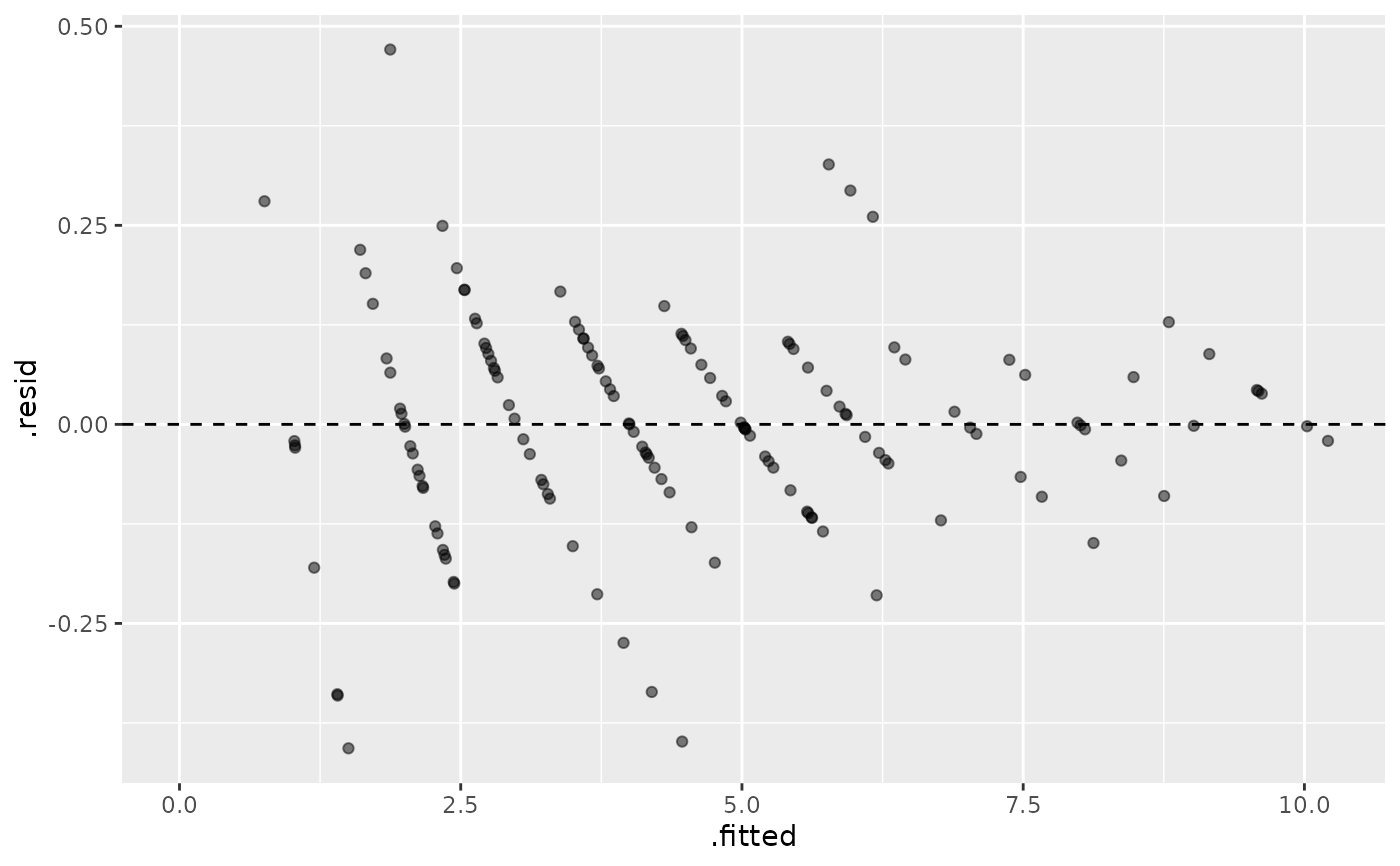
augmented <- augment(fit)
# Plot residuals
library(ggplot2)
ggplot(augmented, aes(x = .fitted, y = .resid)) +
geom_point(alpha = 0.5) +
geom_hline(yintercept = 0, linetype = "dashed")
 # }
# }