
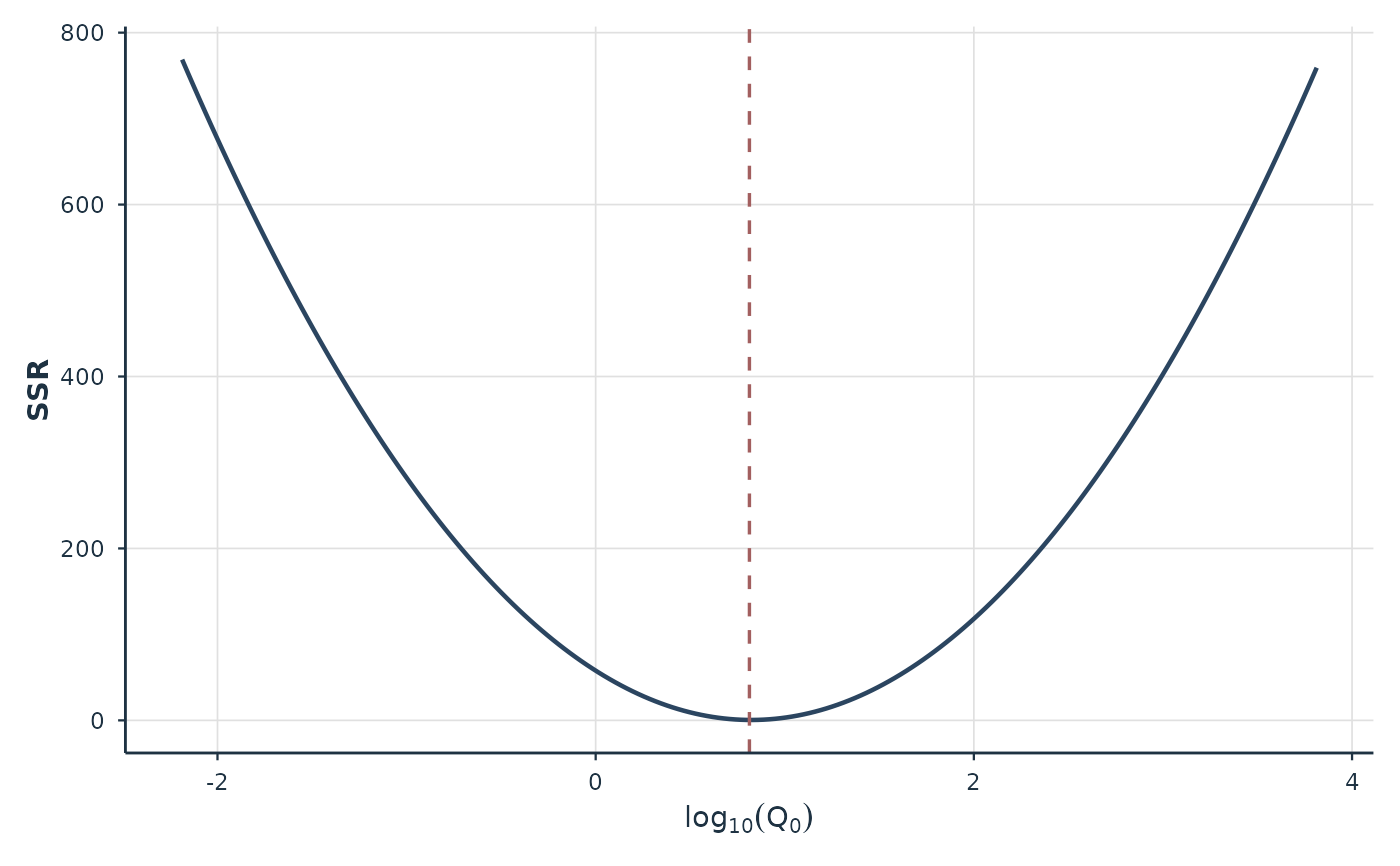
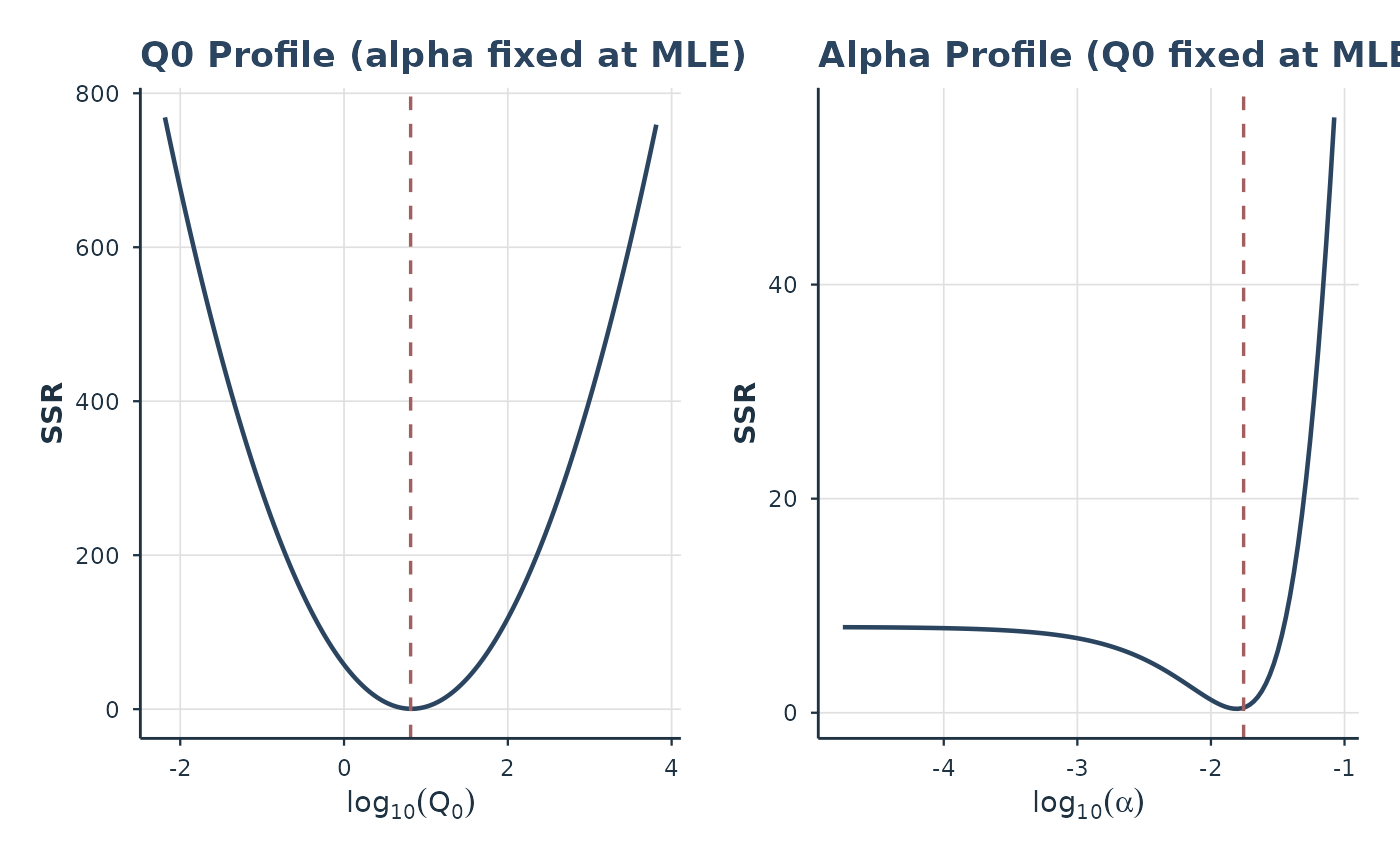
Plots 1D slices of the SSR surface, fixing one parameter at the MLE and varying the other.
Usage
plot_loss_profile(object, ...)

# S3 method for class 'beezdemand_hurdle'
plot_loss_profile(
  object,
  parameter = c("both", "q0", "alpha"),
  resolution = 200,
  range = c(-3, 3),
  style = c("modern", "apa"),
  ...
)

# S3 method for class 'beezdemand_tmb'
plot_loss_profile(
  object,
  parameter = c("both", "q0", "alpha"),
  resolution = 200,
  range = c(-3, 3),
  style = c("modern", "apa"),
  ...
)

# S3 method for class 'beezdemand_nlme'
plot_loss_profile(
  object,
  parameter = c("both", "q0", "alpha"),
  resolution = 200,
  range = c(-3, 3),
  style = c("modern", "apa"),
  type = c("ssr", "marginal"),
  ...
)
Arguments
- object
A fitted model object.
- ...
Additional arguments passed to methods.
- parameter
Character; which parameter to profile:
"q0","alpha", or"both"(default).- resolution
Integer; number of grid points (default 200).
- range
Numeric vector of length 2; range in log10 units relative to MLE (default
c(-3, 3)).- style
Character; plot style,
"modern"or"apa".- type
Character; loss profile to plot for NLME models.
"ssr"(default) profiles sum-of-squared-residuals on price-aggregated means;"marginal"profiles a linearized marginal negative log-likelihood.
Value
A ggplot2 object. If parameter = "both" and patchwork is
available, returns a combined patchwork object.
Examples
# \donttest{
data(apt)
fit <- fit_demand_hurdle(apt, y_var = "y", x_var = "x", id_var = "id")
#> Sample size may be too small for reliable estimation.
#> Subjects: 10, Parameters: 12, Recommended minimum: 60 subjects.
#> Consider using more subjects or the simpler 2-RE model.
#> Fitting HurdleDemand3RE model...
#> Part II: zhao_exponential
#> Subjects: 10, Observations: 160
#> Fixed parameters: 12, Random effects per subject: 3
#> Optimizing...
#> Converged in 81 iterations
#> Computing standard errors...
#> Done. Log-likelihood: 32.81
plot_loss_profile(fit, parameter = "q0")
 plot_loss_profile(fit, parameter = "both")
 # }
# }